Word.Side · Analysis
Vocabulary difficulty and reading progress, explained
Turn the words you look up into a clearer picture of your reading. Compare vocabulary difficulty across books, record your progress, and follow how many different words you look up per page.
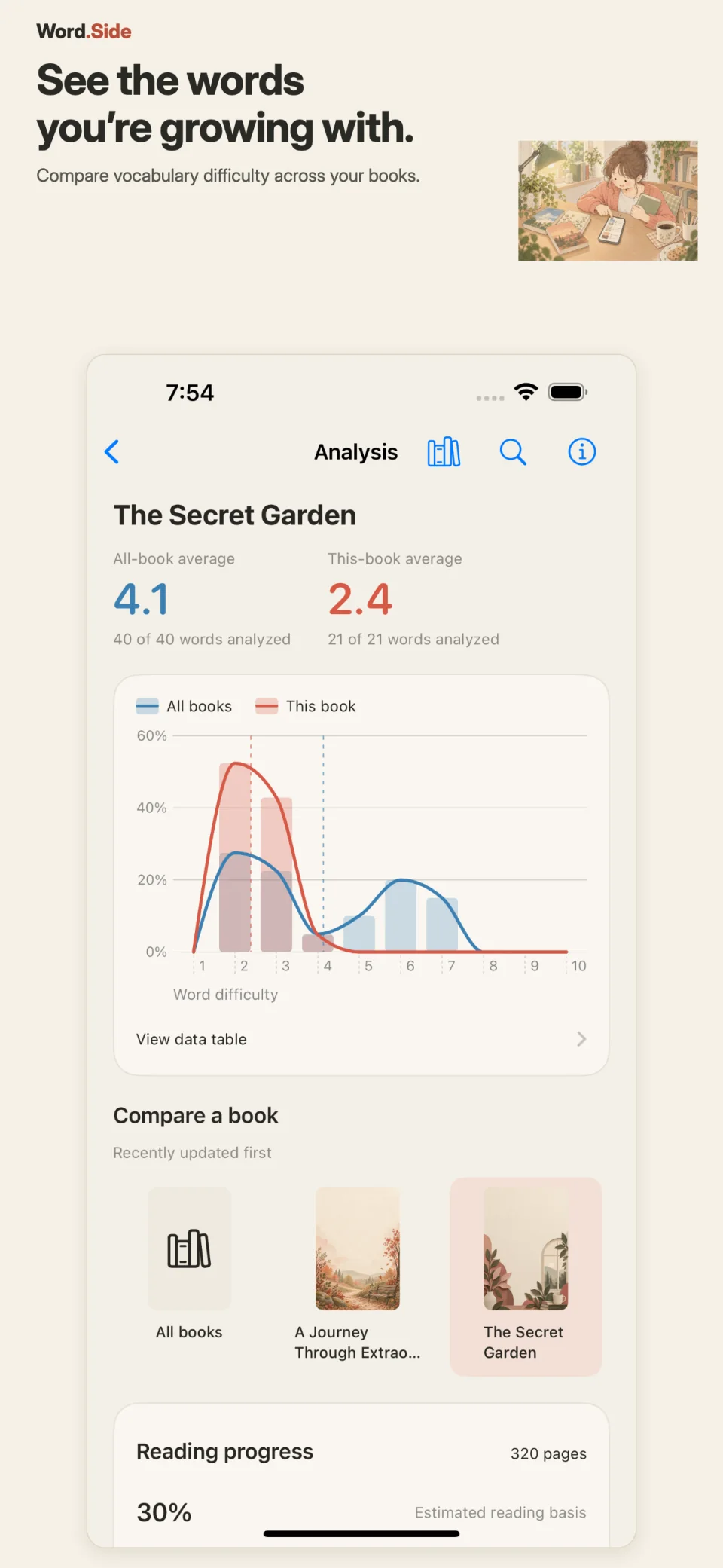
See the words you’re growing with.
Compare vocabulary difficulty across your books.
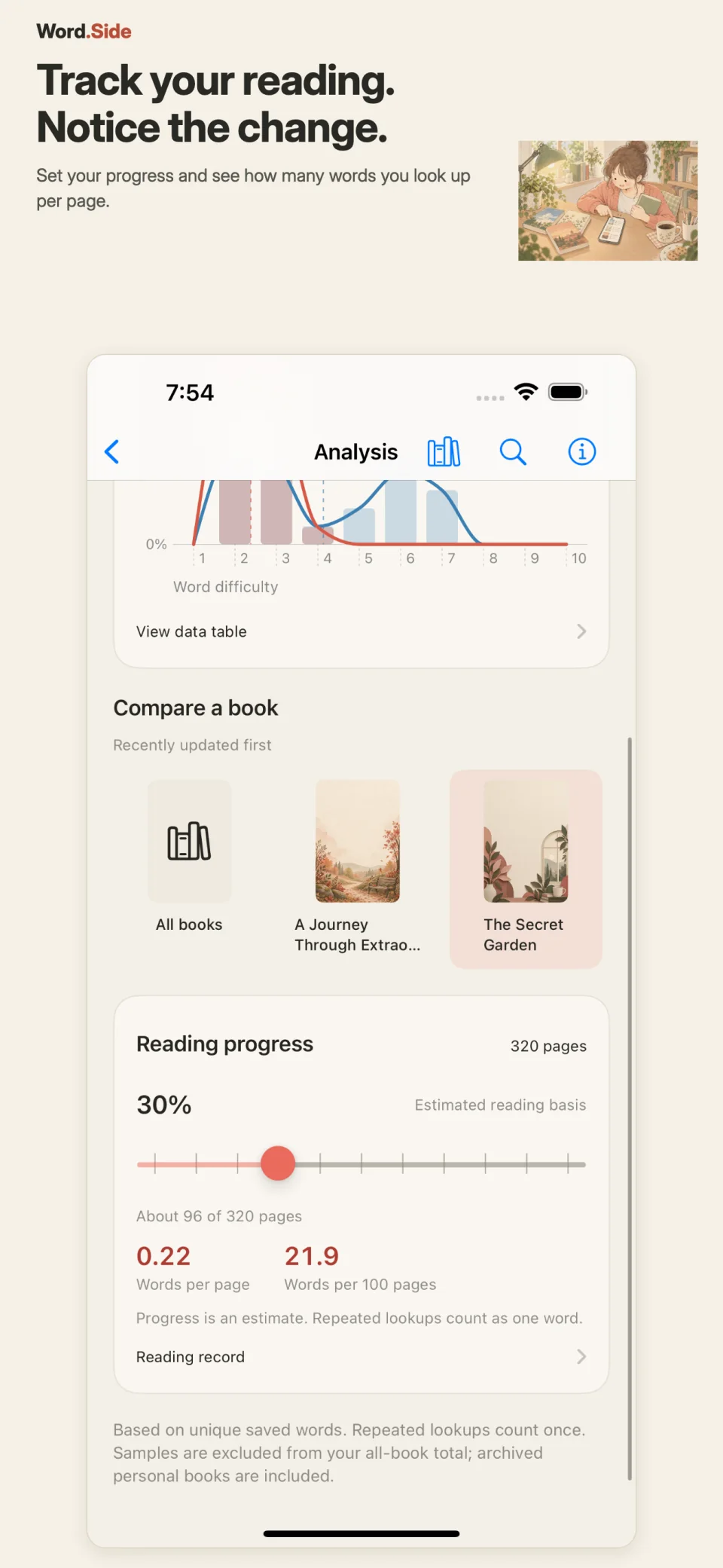
Track your reading. Notice the change.
Set your progress and see how many words you look up per page.
Compare the words in your books
Open Analysis from your bookshelf, or from a book’s wordbook. The histogram groups scored words into ten difficulty bands. Compare one book with all your books, and see the average for the words that have scores.
Understand the difficulty scale
Word difficulty combines frequency evidence with learning-stage information where available. The scale describes how common or rare a word is in the source data: common words sit toward the left, rarer words toward the right. It helps you understand the vocabulary you encounter; it is not a school grade or a proficiency test. Words without a score stay outside the average.
Add pages and move the progress marker
For books found by ISBN, page counts can be filled in when the book data includes them. You can also enter or correct the total yourself. Drag the progress bar to roughly where you are in the book; there is no need to enter every page you read.
Put your lookups in context
Different saved words divided by the estimated pages read gives words looked up per page. For example, 21 words in a 320-page book at 30% progress means about 96 pages read, or 0.22 words per page. Compare similar reading sessions and books over time; the book itself also affects the result.
Why does progress start at 100%?
Until you adjust it, the calculation uses the whole book’s page count. This is a default calculation basis, not a claim that you have finished reading. At 0%, a per-page result is not calculated.
Do repeated searches count as more words?
The per-page figure uses different saved words in that book, not the number of repeated lookups. Add a page count to see the figure, and update your progress as you read.
Keep your attention on your English book
Find a meaning with a few taps. Your words collect automatically in a wordbook for the book you are reading.