
WORD.SIDE · 4 / 4
Learn English through books: a practical reading routine
Choose a readable English book, investigate what blocks understanding, and connect reading with recall and expression.
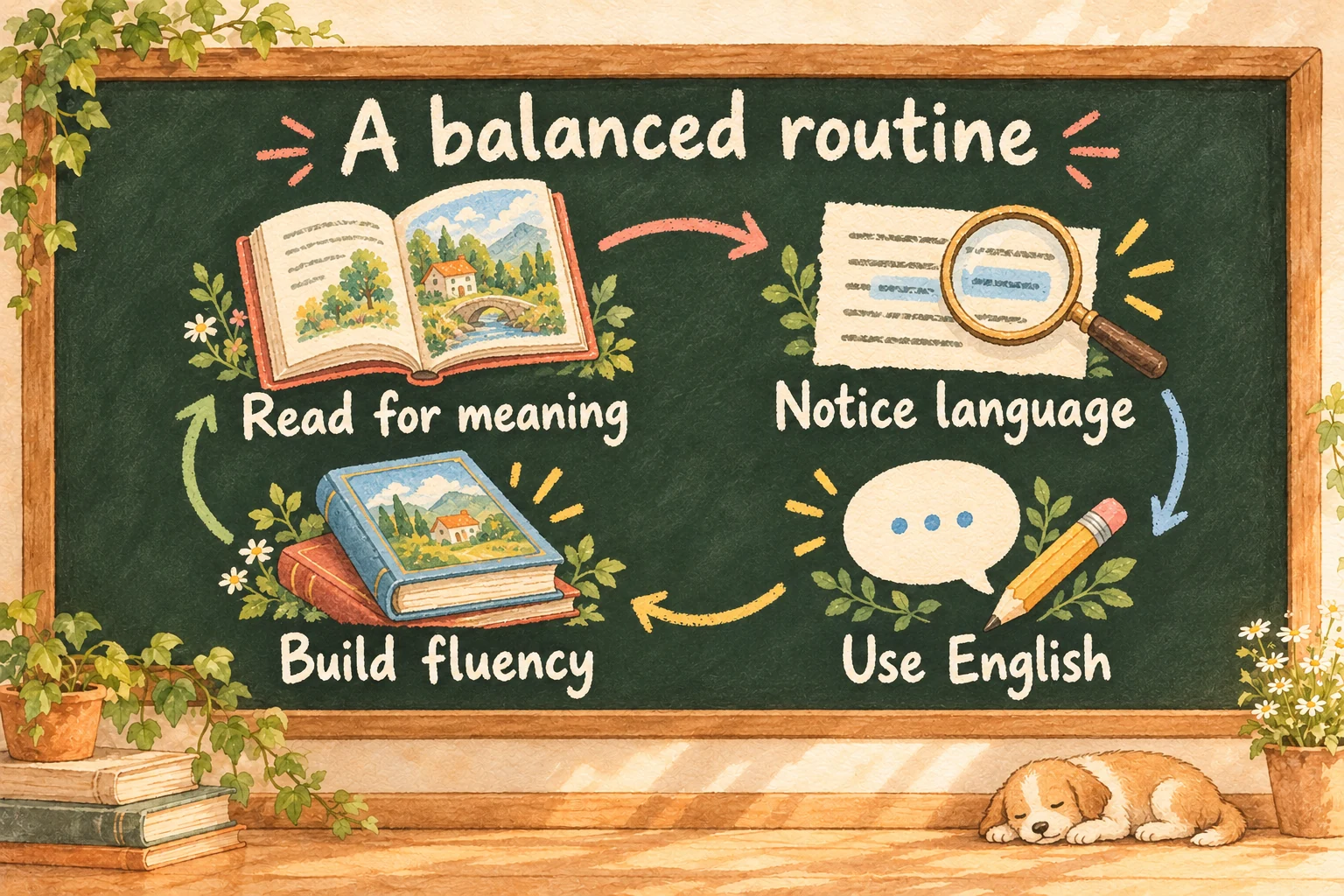
Reading English books to improve your English works best as a repeatable practice, not a test of how difficult a novel you can endure. Start with a story you can follow, then decide what kind of practice you need around it.
Give different activities different jobs
Nation’s four-strand framework combines meaningful input, output, focused language study and fluency practice.[1] These are complementary activities, not compulsory stages in which translation must be mastered before you can read freely. Extensive-reading research also reports reading benefits, without guaranteeing a particular learner’s results.[2]
For your own routine, give an accessible English book the job of keeping meaning moving. Use a short paragraph for close reading when a structure is unclear. Return to familiar material to practise reading more smoothly. Then use an idea from the book in your own English. Translation can help you check a difficult sentence; translating every line need not become the aim of the whole session.
Choose by what happens on the page
Try several pages, including one from the middle. Can you explain who did what? Can you follow a paragraph without rebuilding every sentence? Do you want the next page?
- If unknown words repeatedly hide the action, choose an easier edition, graded reader or more familiar subject.
- If the words are familiar but the sentence is unclear, examine the subject, verb, connectors and references in one paragraph, then resume easier reading.
- If understanding is comfortable, try a slightly more demanding book while keeping an easier book available.
Two to four unfamiliar word occurrences on a page can be a personal browsing cue, not a validated cutoff. Page length, sentence structure and background knowledge change what that count means. No single commercial novel is a universal placement test.
Read Bookfinder’s three signals correctly
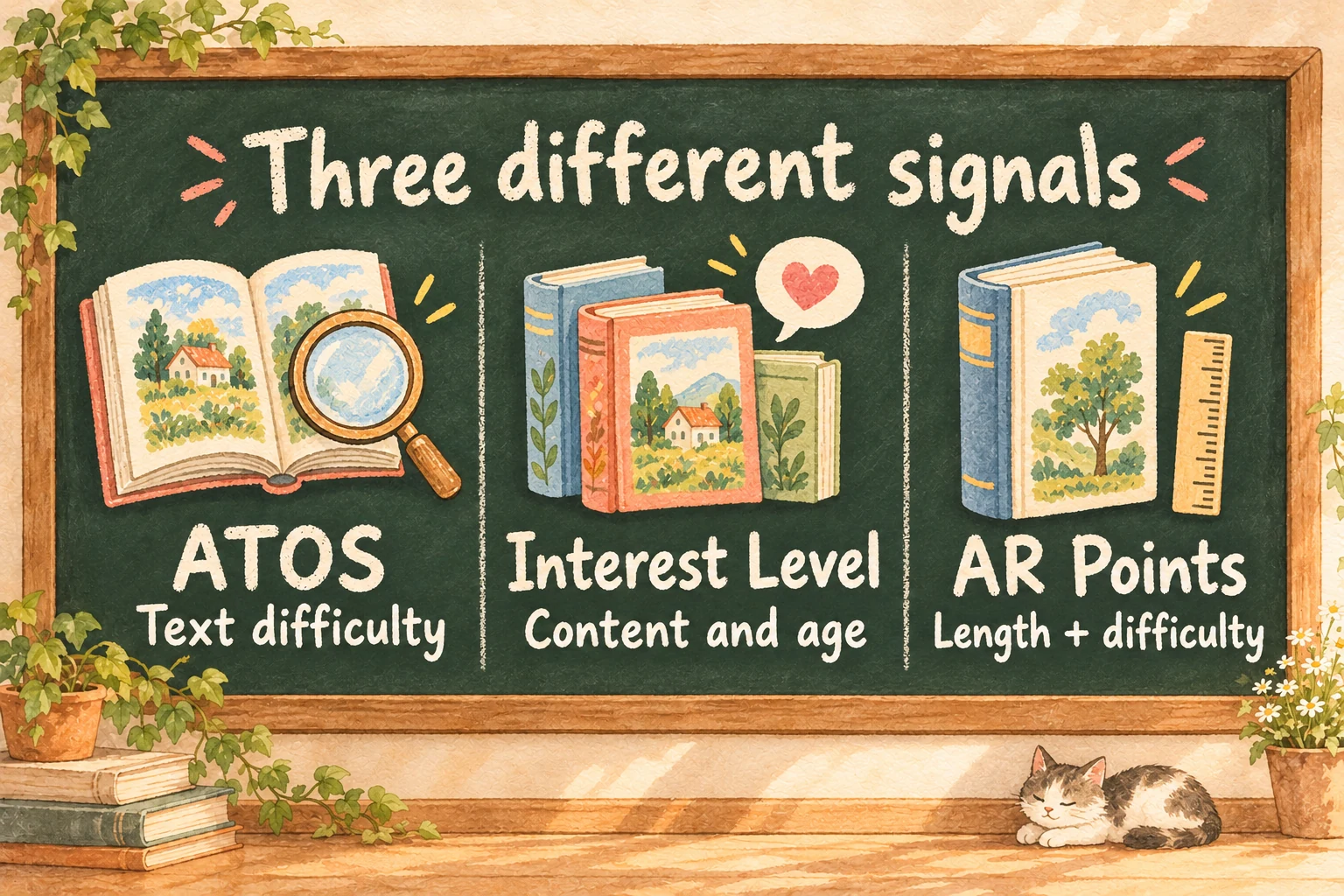
AR Bookfinder can help narrow your search, but its fields answer different questions:
- ATOS Book Level: an estimate of text readability, expressed on a US grade-based scale.[3]
- Interest Level: content and age appropriateness, not how interesting you personally will find the story.[4]
- AR Points: a value based on length and difficulty; it is not a difficulty score by itself.[5]
Use ATOS to shortlist, check the themes, and then read sample pages. A grade-based estimate is not an adult learner’s CEFR level. Choosing Upper Grades does not automatically make a book more engaging, and a low point total does not automatically make it easy.
Keep a guess provisional, and a lookup brief
Context can suggest a meaning. When that meaning determines the action, seems uncertain, or keeps recurring, check it and reread the sentence. Research distinguishes inferring, verifying and memorizing; it does not justify banning inference altogether.[6] Our practical recommendation is to confirm important meanings without turning every minor gap into a long detour. A correct dictionary entry still needs the sense that fits this sentence.
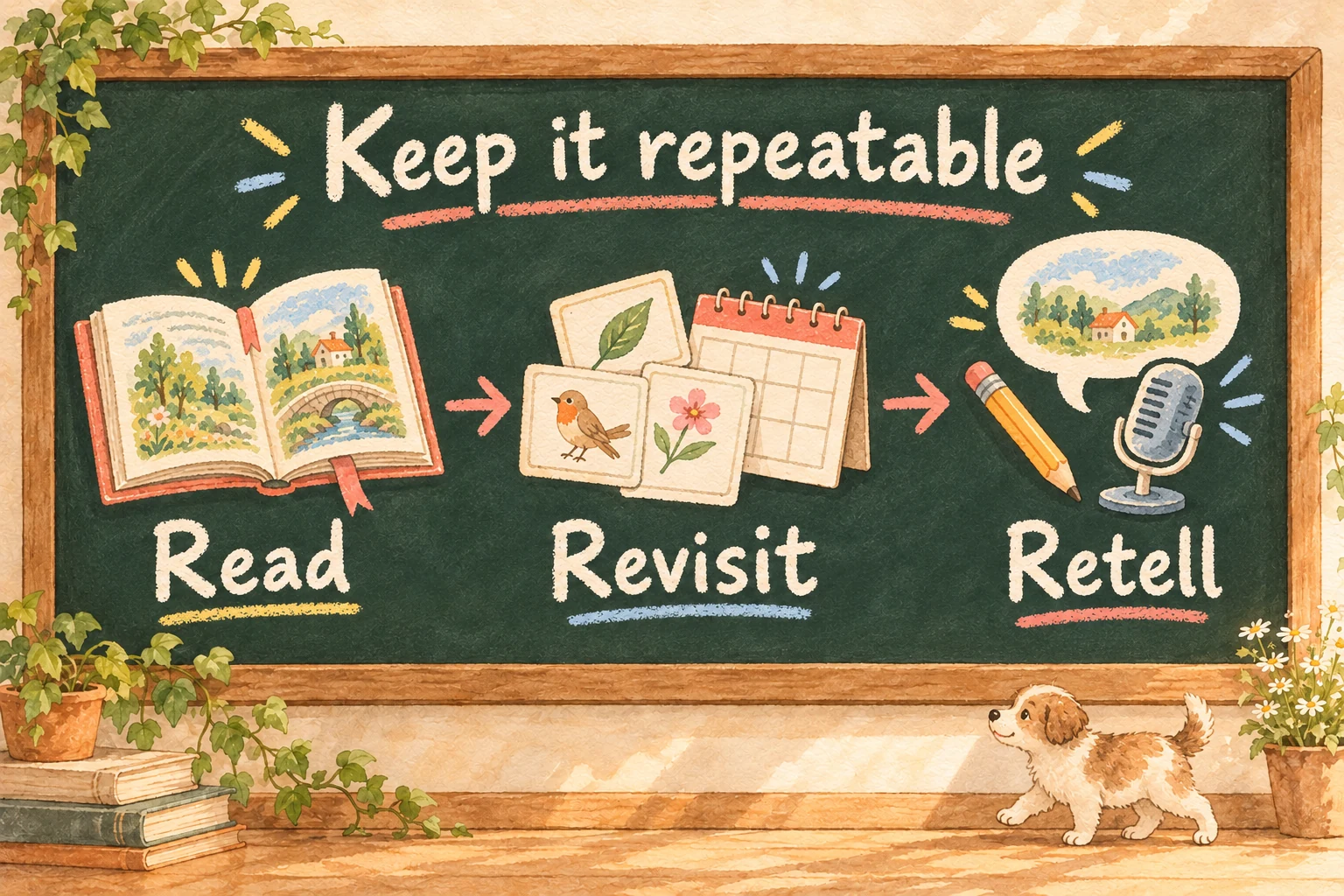
Read, revisit, retell
Spaced practice can support second-language learning.[7] Vocabulary experiments also support practising recall rather than only rereading answers.[8] Neither finding specifies a universal monthly quota or one ideal schedule.
Try this flexible cycle: read for a comfortable stretch; choose one sentence worth understanding closely; keep a few useful words with their book. On another day, try recalling those meanings before revealing them. Revisit a short passage, then write a couple of sentences or record a brief retelling without looking at the original. Compare your version with the scene and seek feedback when possible. This is an editorial practice example, not a tested WordSide learning programme.
Once a week, ask what is blocking you: word recognition, sentence understanding, or expressing an idea. Adjust that activity rather than merely raising a page target. WordSide’s role is to keep the dictionary detour small and collect looked-up words with the selected book, so the story remains central. The cited studies did not test WordSide. Continue with a book you understand well enough to want to open again.
References
- Paul Nation (2007). The Four Strands. Innovation in Language Learning and Teaching, 1(1), 2–13.
- Takayuki Nakanishi (2015). A Meta-Analysis of Extensive Reading Research. TESOL Quarterly, 49(1), 6–37.
- Renaissance. What is ATOS? Official readability explanation.
- Renaissance. Interest Level. Official content and age-appropriateness guidance.
- Renaissance. Getting Results with Accelerated Reader. Book Level, Interest Level and Points.
- Jan-Arjen Mondria (2003). The Effects of Inferring, Verifying, and Memorizing on the Retention of L2 Word Meanings. Studies in Second Language Acquisition, 25(4), 473–499.
- Su Kyung Kim and Stuart Webb (2022). The Effects of Spaced Practice on Second Language Learning: A Meta-Analysis. Language Learning, 72(1), 269–319.
- Jeffrey D. Karpicke and Henry L. Roediger III (2008). The Critical Importance of Retrieval for Learning. Science, 319, 966–968.
Keep your attention on your English book
Find a meaning with a few taps. Your words collect automatically in a wordbook for the book you are reading.