WORD.SIDE · 2 / 4
Choose your next English book
A few sample pages can tell you more than a difficulty label. Test the language, the subject, and your desire to keep reading.
When you read English books to improve your English, choosing a book you can follow is part of making the habit last.
The right next book gives you two reasons to continue: you can follow enough of the language, and you care about what happens. A level label can narrow the shelf, but it cannot choose your interests. Before committing, open a few pages from the beginning and somewhere in the middle. Try reading them as a reader, without preparing a translation.
Use the page as a small trial
Ask who is speaking, what has changed, and what you want to know next. If you recognize the words but lose the sentence, grammar may be the obstacle. If every name, custom, or setting is unfamiliar, background knowledge may be doing more work than the vocabulary count suggests. A familiar subject or a graded reader can make a better starting point.
Vocabulary-coverage studies discuss conditions around 95–98%, [1] while a 2023 replication cautions against a universal cutoff. [2] These figures are context, not a pass mark that guarantees understanding. Plot, grammar, prior knowledge, and your purpose still matter.
Count occurrences, then listen to your reading
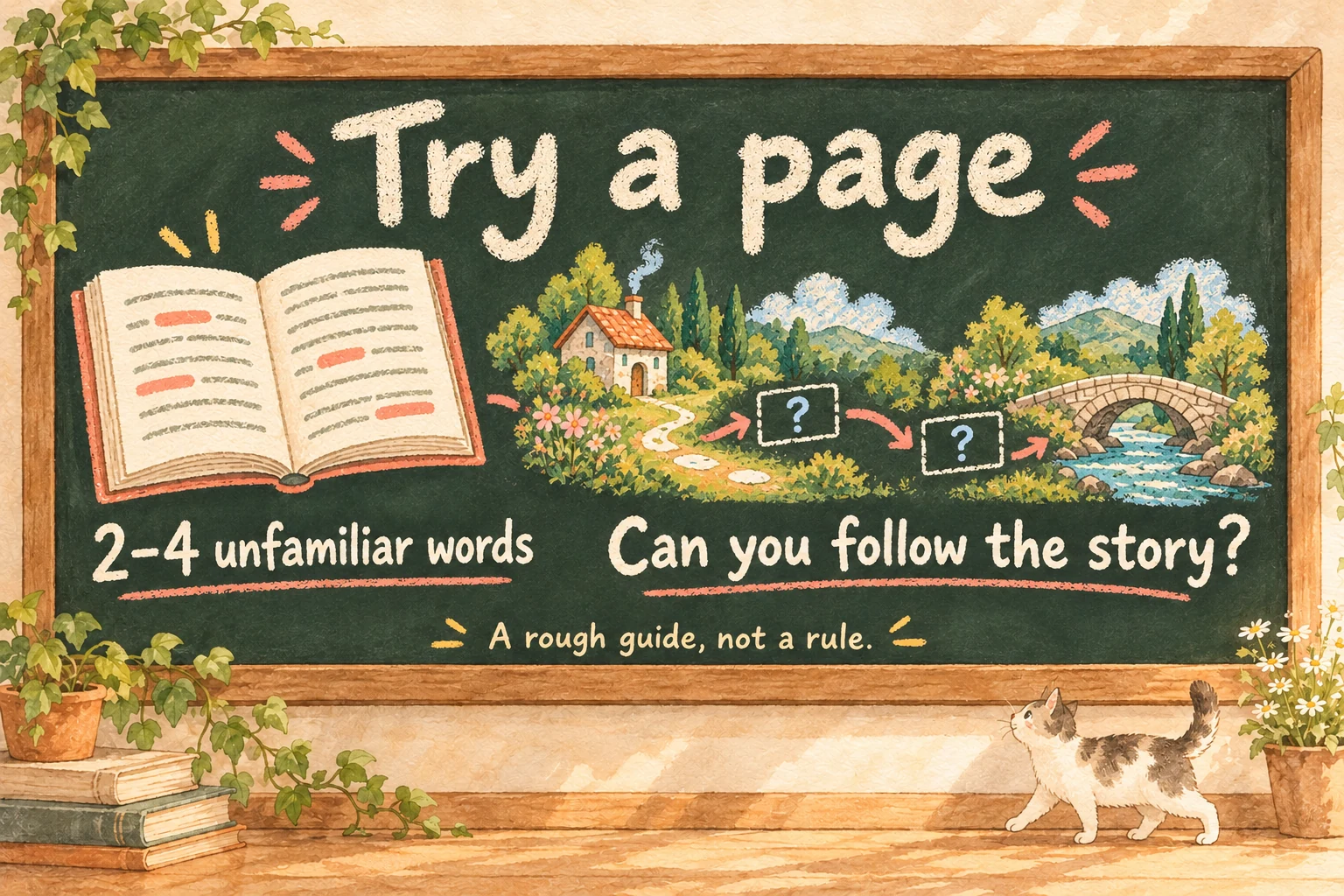
As our own rough browsing heuristic, try a page with only two to four unfamiliar word occurrences. Count each occurrence, including repetitions, rather than only distinct dictionary entries. On a 250-word page, that means 246–248 familiar occurrences: 98.4–99.2% by simple arithmetic. The calculation is not a research-validated threshold or a promise of easy reading.
Use it to start a conversation with the page. Can you follow the action despite those gaps? Are you stopping so often that the scene disappears? A short page, a technical topic, or one crucial unknown word can make the same count feel very different. You can choose an easier edition without abandoning the subject you enjoy.
Keep the tools smaller than the story
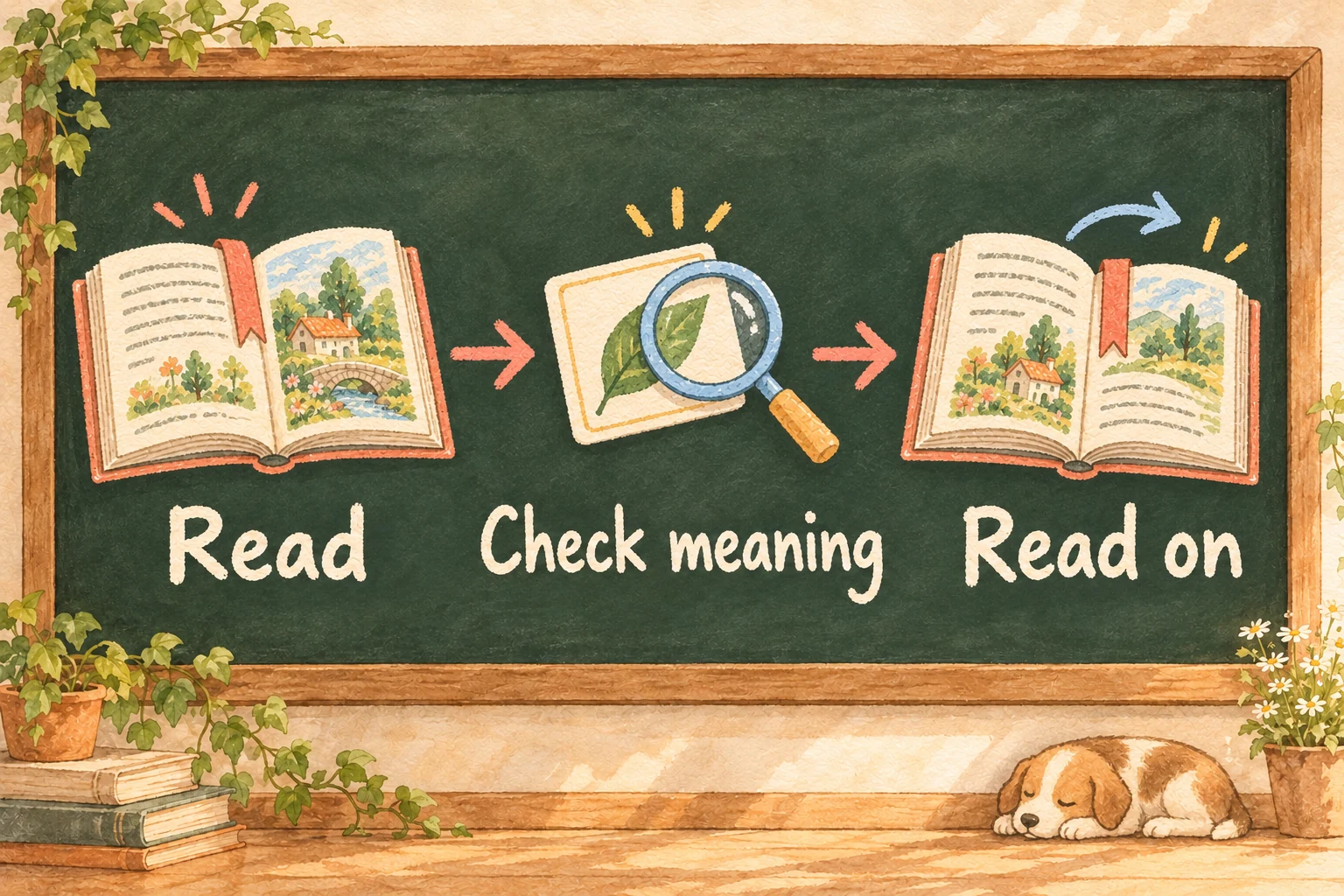
Use a dictionary for a blocked idea, then reread the sentence. Keep notes short enough that you can return immediately: a useful meaning, the book, perhaps a reminder of the scene. You do not owe every unfamiliar word a permanent place in a list.
After a short session, decide whether you want the next page. Keep the book, try another chapter, or exchange it for something clearer. This is a reading choice, not a verdict on your ability. The useful difficulty is the one you can live with long enough to discover a story.
References
- Batia Laufer and Geke C. Ravenhorst-Kalovski (2010). Lexical threshold revisited: Lexical text coverage, learners’ vocabulary size and reading comprehension. Reading in a Foreign Language, 22(1), 15–30.
- Benjamin Kremmel, Bimali Indrarathne, Judit Kormos and Shungo Suzuki (2023). Unknown Vocabulary Density and Reading Comprehension: Replicating Hu and Nation (2000). Language Learning, 73(4), 1127–1163.
Keep your attention on your English book
Find a meaning with a few taps. Your words collect automatically in a wordbook for the book you are reading.